The essay was written by Gertrude Stein who was an American author and poet, as well as a major art collector. The essay was written in 1935 and then delivered as a speech at Oxford and Cambridge in 1936. The audience for whom she wrote the essay seems to be a well-educated group of people who may write or do other forms of creative expression often, as shown through certain statements Stein makes. For example she writes, "Any of you when you write you try to remember what you are about to write and you will see immediately how lifeless the writing becomes that is why expository writing is so dull because it is all remembered." Throughout this barely-punctuated and hard-to-understand essay, Stein attempts to define what exactly master-pieces are, why there are so few of them, and why people are often mistaken in describing something as a master-piece. She argues, "You may say after all there are a good many of them but in any kind of proportion with everything that anybody who does anything is doing there are really very few of them." In addition, Stein goes on to explain what
makes something
not a master-piece. She writes, "Therefore a master-piece has essentially not to be necessary, it has to be that is it has to exist but it does not have to be necessary it is not in response to necessity as action is because the minute it is necessary it has in it no possibility of going on." Throughout the rest of the essay, Stein explains that master-pieces must be unrelated to time, as well as unrelated to identity. This abstract matter, and the way the essay is written, makes Stein's ideas difficult to understand. The syntax she uses is that of very long and run-on sentences that repeat ideas and words frequently. Many times Stein will write almost identical sentences only a few paragraphs later. While the reader certainly does get a better understanding of what master-pieces are, and the way Stein defines them in her own life, the essay itself makes her ideas difficult to understand.
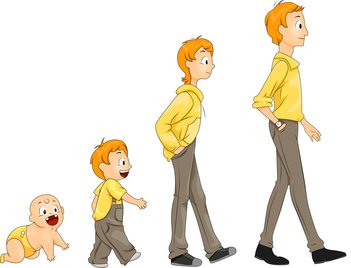
Boy to Man
In her essay, Stein highlights the idea of humans not being master-pieces because a boy is first a boy before he becomes a man, and the process involves time as well as identity.
Photo: LifeStages Center

No comments:
Post a Comment