Thursday, August 27, 2015

Total Eclipse

The essay was written by Pulitzer Prize winner Annie Dillard who is an American fiction and nonfiction writer.  The essay was first published in 1982 in Antaeus.  Dillard wrote her essay in order to make her message known to all adults, even (and especially) adventurous ones.  In her essay, Dillard describes the details of a total eclipse that she witnessed with her husband Gary in a town near Yakima in central Washington.  She writes of how the eclipse "began with no ado" and how "from all the hills came screams".  As Dillard describes watching the eclipse she is able to bring the audience into the moment with her.  Dillard also details the moment when she looked at her husband.  She writes, "He was in a film.  Everything was lost.  He was a platinum print, a dead artist's version of life."  Her imagery is so great that the reader feels as though they are watching the eclipse alongside her.  By using the first person narrative, Dillard is able to successfully describe her experience as well as make her message known.  At the end of the essay she writes, "One turns at last even from glory itself with a sigh of relief.  From the depths of mystery, and even from the heights of splendor, we bounce back and hurry for the latitudes of home."  Here, Dillard is discussing how she believes that even in an event so rare and great as an eclipse, people still rush to get back to what is familiar.  She references turning away from glory with relief, because glory is something that is unknown for humans and can be scary and difficult to enjoy.  Dillard is able to accomplish her goal of detailing her eclipse as well as getting her message across through her use of relatable and elegant language.  For example she writes, "It was like slipping into fever, or falling down that hole in sleep from which you wake yourself whimpering."  By using imagery that is familiar to her readers, Dillard is able to write a successful and enthralling essay.

Vegetable Clown
In her essay, Dillard discusses a detail that she remembers vividly from her trip to see the eclipse.  She writes, "During those years I have forgotten, I assume, a great many things I wanted to remember - but I have not forgotten that clown painting or its lunatic setting in the old hotel."  These details help the reader better understand the mindset that Dillard was in during her experience.
Photo: WebMD


The White Album

The essay was written by Joan Didion who is an American novelist and essayist.  Her writings often focus on the topics of disorder as well as social and personal unrest.  Most of the essay was written in 1979, but parts of it were written in 1968 and 1969 as part of another project.  Didion wrote the essay for adults in order to educate about the times of disorder during the sixties, as well as to discuss her personal reactions and experiences during that time period.  The essay starts with Didion setting the scene.  She writes, "I suppose this period began around 1966 and continued until 1971.  During those five years I appeared on the face of it, a competent enough member of some community or another, a signer of contracts and Air travel cards..."  Here, Didion begins to tell of her experiences during those five years when she began to doubt the order and "script" of everything in her life.  Throughout the rest of the essay, she tells of her experience watching The Doors record their album, of learning about the trial of the Ferguson brothers, of speaking with accused murderer Linda Kasabian, and her interactions with one of the faces of the Black Panther Party, Huey P. Newton.  Throughout the essay, Didion's purpose is to show the disorder of everything that was happening in the sixties.  She speaks of this period as a time of paranoia and unrest, and educates the reader about events in a personal and emotional matter.  At one point Didion is speaking to Huey Newton after his arrest for killing a police officer.  He says, "It reminds me of a quote from James Baldwin: 'To be black and conscious in America is to be in a constant state of rage.'" This quote shows the unrest during the time that Didion is trying to inform the reader about.  With her use of the first person as well as appealing language, Didion is able to get her story, and her message, across to the reader very well.  In the end, Didion highlights her own ongoing confusion and distress by writing, "Quite often I reflect on the big house in Hollywood, on 'Midnight Confessions' and on Ramon Novarro...but writing has not yet helped me to see what it means."

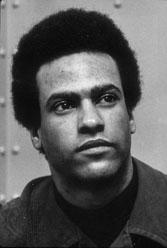
Huey P. Newton
A major source of Didion's obsession with disorder and unrest comes from the arrest of Huey Newton after he was accused of murdering a police officer, wounding one more and kidnapping a bystander.  Many of his quotes seem to define the time period for Didion.
Photo: Biography.com

What Are Master-pieces and Why Are There So Few of Them

The essay was written by Gertrude Stein who was an American author and poet, as well as a major art collector.  The essay was written in 1935 and then delivered as a speech at Oxford and Cambridge in 1936.  The audience for whom she wrote the essay seems to be a well-educated group of people who may write or do other forms of creative expression often, as shown through certain statements Stein makes.  For example she writes, "Any of you when you write you try to remember what you are about to write and you will see immediately how lifeless the writing becomes that is why expository writing is so dull because it is all remembered."  Throughout this barely-punctuated and hard-to-understand essay, Stein attempts to define what exactly master-pieces are, why there are so few of them, and why people are often mistaken in describing something as a master-piece.  She argues, "You may say after all there are a good many of them but in any kind of proportion with everything that anybody who does anything is doing there are really very few of them."  In addition, Stein goes on to explain what makes something not a master-piece.  She writes, "Therefore a master-piece has essentially not to be necessary, it has to be that is it has to exist but it does not have to be necessary it is not in response to necessity as action is because the minute it is necessary it has in it no possibility of going on."  Throughout the rest of the essay, Stein explains that master-pieces must be unrelated to time, as well as unrelated to identity.  This abstract matter, and the way the essay is written, makes Stein's ideas difficult to understand.  The syntax she uses is that of very long and run-on sentences that repeat ideas and words frequently.  Many times Stein will write almost identical sentences only a few paragraphs later.  While the reader certainly does get a better understanding of what master-pieces are, and the way Stein defines them in her own life, the essay itself makes her ideas difficult to understand.

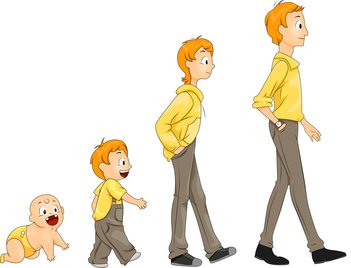
Boy to Man
In her essay, Stein highlights the idea of humans not being master-pieces because a boy is first a boy before he becomes a man, and the process involves time as well as identity.
Photo: LifeStages Center