The essay was written by Joan Didion who is an American novelist and essayist. Her writings often focus on the topics of disorder as well as social and personal unrest. Most of the essay was written in 1979, but parts of it were written in 1968 and 1969 as part of another project. Didion wrote the essay for adults in order to educate about the times of disorder during the sixties, as well as to discuss her personal reactions and experiences during that time period. The essay starts with Didion setting the scene. She writes, "I suppose this period began around 1966 and continued until 1971. During those five years I appeared on the face of it, a competent enough member of some community or another, a signer of contracts and Air travel cards..." Here, Didion begins to tell of her experiences during those five years when she began to doubt the order and "script" of everything in her life. Throughout the rest of the essay, she tells of her experience watching The Doors record their album, of learning about the trial of the Ferguson brothers, of speaking with accused murderer Linda Kasabian, and her interactions with one of the faces of the Black Panther Party, Huey P. Newton. Throughout the essay, Didion's purpose is to show the disorder of everything that was happening in the sixties. She speaks of this period as a time of paranoia and unrest, and educates the reader about events in a personal and emotional matter. At one point Didion is speaking to Huey Newton after his arrest for killing a police officer. He says, "It reminds me of a quote from James Baldwin: 'To be black and conscious in America is to be in a constant state of rage.'" This quote shows the unrest during the time that Didion is trying to inform the reader about. With her use of the first person as well as appealing language, Didion is able to get her story, and her message, across to the reader very well. In the end, Didion highlights her own ongoing confusion and distress by writing, "Quite often I reflect on the big house in Hollywood, on 'Midnight Confessions' and on Ramon Novarro...but writing has not yet helped me to see what it means."
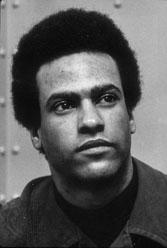
Huey P. Newton
A major source of Didion's obsession with disorder and unrest comes from the arrest of Huey Newton after he was accused of murdering a police officer, wounding one more and kidnapping a bystander. Many of his quotes seem to define the time period for Didion.
Photo: Biography.com

No comments:
Post a Comment