David Foster Wallace grew up in Philo, Illinois, a town filled with vast farmlands and frequent tornado warnings. In his essay, Derivative Sport in Tornado Alley, Wallace speaks of the way his experiences as a child shaped who he grew up to be, as well as the still-important details he holds in his mind from long days spent on tennis courts, amidst gusty winds and clouds of bugs. The details Wallace remembers represent the importance of the concept of knowing where you come from, an idea that is absolutely important and applicable to anyone.
When Wallace was younger, he was in the top twenty of junior tennis players for his region. Wallace uses tennis to account for his later love of math. The sharp angles of the court and the curves of the ball were comfortable to Wallace, and when he moved to the east for college, these familiar angles and curves felt like coming home. In my own life, it is important to remember the details that shaped me. Vague memories of songs I used to sing and games I used to play still make their way into my daily life. These experiences taught me a love for something nearly intangible, and when I come across them nowadays, it does indeed feel like coming home. The detail with which Wallace is able to describe the experiences he had shows how these details provide a sort of timeline in his life. Remembering details and using them to understand greater concepts of what is happening around us is a great way to stay grounded and remember the journey we have made to get where we are today.
Small details and childhood-loves follow us wherever we end up in the future. It is nearly impossible to end up a different product than the sum of the small details and experiences we grew up. The smells and sights of the typical days of our childhoods translate to later loves of cut grass or sunsets. In his essay, Wallace describes, through detailed accounts of tennis matches and tornado warnings, the experiences that made him who he later became. In this way, Wallace shows how important it is for everyone to take in the small details of their everyday lives and remember where they came from.
Sunday, February 28, 2016

Sunday, February 21, 2016
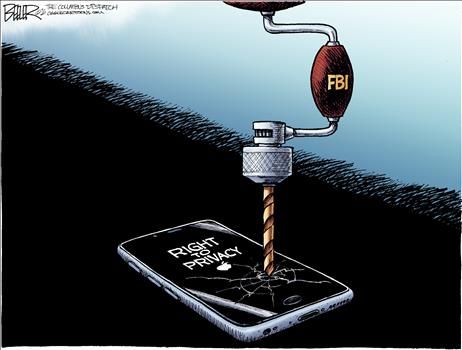
TOW #18 - Political Cartoon
After the recent shooting at a health center in San Bernardino, California, there has been much speculation about who the shooters were, what their intentions were, and how they were able to carry out the kind of attack they did. While the FBI does possess one of the shooter's phones, they cannot unlock it due to a password, as well as the privacy rights guaranteed by Apple, the maker of the phone. The US government is now asking Apple to create and install a software that would allow the phone to be unlocked, in order for more information to be discovered about the shooting, and the shooters themselves. While privacy is certainly a right that should be guaranteed to all citizens, when national security is at stake, companies should have an obligation to work with the government.
The political cartoon depicts the FBI putting a screw into an iPhone which reads, "Right to Privacy". The cartoon is arguing that the FBI is hurting the policies that Apple holds to be true with their intent on discovering what secrets the phone holds. Due to incidents in the past with national security, such as those brought up by Edward Snowden, Apple is standing firm on their policies. Their main concern is that with the development of a software that can unlock the phone, this software could be stolen in the future and used to unlock any iPhone that exists. While this is certainly a legitimate concern, it would seem that Apple technicians are specialized so completely and dominantly for their market, that they should be able to work around this issue when it comes to such a big problem as national security.
The incident in San Bernardino and the events that have followed it have upset many people on both sides of the issue. The entire country felt the effects of the shooting and the mourning that followed. Those that are worried about their privacy have valid concerns, however, sometimes the safety and well-being of the country must come before the individual. We must put our trust in Apple and believe that they will be able to work through this problem without risking our national security.
Friday, February 12, 2016
TOW #17 - Before the Law
Nearly six years ago, Kalief Browder was arrested while on his way home with a friend. He was placed in handcuffs and told he was being taken in for robbing a Mexican immigrant of his backpack three days prior. Browder knew he was innocent, and maintained this innocence for the three years he endured on Rikers, the island that houses New York City's main prisons. With almost almost eight hundred days in solitary confinement, Browder is now living his days attempting to forget what occurred in the years that stole his adolescence. Although some would argue it's nearly impossible to improve these conditions in a city of eight million, the conditions of the jails are inhumane, and the constitutional amendments we seemingly all have, are not being explicitly provided to each and every person.
For starters, Browder details the abuse the inmates endured at the hands of the guards. These guards, supposedly the peace keepers and guardians of the group of young men, "had an agreement with the gang members" that controlled R.N.D.C (where Browder was housed). In addition after lining the men up and beating them, "they made it clear that, if the inmates went to the clinic and told the medical staff what had happened, they would write up charges against them, and get them sent to solitary confinement". These guards did not use force when it was necessary, they used force when they felt it would be entertaining and beneficial for themselves. The corrupted system doesn't account for these issues, yet it should. A man who is arrested on charges, be him innocent or guilty, can not be afraid for his life at the hands of the people supposedly protecting him.
Browder, during his three years on Rikers, spent almost eight hundred days in solitary confinement. "Between 2007 and mid-2013, the total number of solitary-confinement beds on Rikers increased by more than sixty per cent, and a report last fall found that nearly twenty-seven per cent of the adolescent inmates were in solitary." Solitary confinement is detrimental to a person's mental health, and Browder is still recovering from the time spent there. He attempted suicide multiple times while in solitary confinement. This good kid, from a good family, who had committed no crime, was now attempting to end his life with a sharpened piece of plastic from the one bucket he was given for his time on the island. The issues within the social justice system must be accounted for, and the life taken away from Browder must not be taken away from more young men in this way again.

For starters, Browder details the abuse the inmates endured at the hands of the guards. These guards, supposedly the peace keepers and guardians of the group of young men, "had an agreement with the gang members" that controlled R.N.D.C (where Browder was housed). In addition after lining the men up and beating them, "they made it clear that, if the inmates went to the clinic and told the medical staff what had happened, they would write up charges against them, and get them sent to solitary confinement". These guards did not use force when it was necessary, they used force when they felt it would be entertaining and beneficial for themselves. The corrupted system doesn't account for these issues, yet it should. A man who is arrested on charges, be him innocent or guilty, can not be afraid for his life at the hands of the people supposedly protecting him.
Browder, during his three years on Rikers, spent almost eight hundred days in solitary confinement. "Between 2007 and mid-2013, the total number of solitary-confinement beds on Rikers increased by more than sixty per cent, and a report last fall found that nearly twenty-seven per cent of the adolescent inmates were in solitary." Solitary confinement is detrimental to a person's mental health, and Browder is still recovering from the time spent there. He attempted suicide multiple times while in solitary confinement. This good kid, from a good family, who had committed no crime, was now attempting to end his life with a sharpened piece of plastic from the one bucket he was given for his time on the island. The issues within the social justice system must be accounted for, and the life taken away from Browder must not be taken away from more young men in this way again.
Kalief Browder committed suicide at his home in the Bronx in June of 2015.
Subscribe to:
Posts (Atom)