David Foster Wallace is one of those authors who has experienced a great deal of pain in his life. He dealt with depression, and ended up killing himself in the later years of his life. However, through his writing shines a certain stubbornness and willingness to understand the world and all that comes with it. In Shipping Out: On the (nearly lethal) Comforts of a Luxury Cruise, Wallace's darkness shines through as well. He discusses a young kid, 16 years old, who jumped from the top of another cruise ship. Through this anecdote, Wallace is able to highlight the grossness of American cruise culture, and American culture in general.
Wallace wrote the piece for Harper's Magazine after they sent him on the cruise. However, it is clear that being on a cruise is not exactly where Wallace is meant to be. He discusses almost objectively the different aspects of the cruise that push him towards suicide. The terribly ironic part is that when the article was first released it was entirely humorous, and the audience had a good time laughing at the clear stereotypes of cruise-goers from far away. When looked at on a deeper level, the essay has a dark tone. It picks apart each of the people Wallace meets and looks at them in the broadest sense possible so as to identify the characteristics of an entire group. Wallace many times will say, "I like him/her but...". He can't seem to directly interact with anyone around him, and everyone he meets seems to be below his standards.
Wallace is an extremely interesting writer to read because of the way he is able to distance himself from the topics he talks about. Although this tone often comes off as snarky and pretentious, Wallace has a distinguished way of viewing the world that is fascinating to a reader. His comments about the ship are definitely insulting, but it is the way in which they are clearly true that shows Wallace's genius. Wallace knows how to look at those around him, and his attitude of feeling as if he is better than them comes from the fact that, in many ways, he is. Wallace went through the darkest times anyone can go through, yet his commentary reaches for generations to come.
Sunday, April 17, 2016

Sunday, April 10, 2016
TOW #23 - Things We Think We Know
In our modern world, stereotypes are the thing we say we avoid, yet exploit endlessly to our friends and colleagues. Whether purposely or not, stereotypes define how we tend to see each other, and how we are able to justify the ways in which we classify those unfamiliar to us. In his essay, Things We Think We Know, Chuck Klosterman discusses stereotypes, especially those that reach international lengths. While never refuting the oppressive existence of stereotypes, Klosterman is able to bring about a call to action of sorts, after describing his visit to Germany.
While traveling around Germany, Klosterman found the inescapable presence of American stereotypes. And not the stereotypes that Americans have about Germans, which are obviously plenty. Instead, Klosterman focused on the stereotypes that Germans have about Americans. The overabundance of people believing that all Americans do is watch Baywatch, since that's what Joey from Friends liked to do, was immense. Even though this stereotype seems far fetched, the small bits of information we get are what we hold onto. If Joey was in a German TV show and all he liked to do was watch Barney, Americans would believe that this is what Germans liked to do in their free time as well. As humans, we tend to hold on to the pieces of information that we can make sense of, and this information is what becomes our stereotypes. Klosterman uses his personal anecdotes from his time in Germany to describe how these stereotypes come about, and how to fight against them.
In his ending points, the author is describing how he spent time at a bar with a couple of guys from Michigan, as well as a man from Australia who was working for the king of Bahrain. Even though all of these men gave Klosterman information about where they came from, Klosterman was only getting the tiniest sliver of what life was like in their homes.
While talking to these men in the bar, Klosterman was able to finally decipher how stereotypes come about. They come from humans taking hold onto the smallest pieces of information they can find, and then allowing that information to become their basis of knowledge for anyone who comes from the same place. While Klosterman could have taken all of the bits of observations he noted about Germans, he chose instead to admit that he really still didn't know anything about Germans, or Germany. By not allowing himself to define an entire country by a few weeks of observations, Klosterman fought against our intense love of sterotypes, and the things we think we know.
While talking to these men in the bar, Klosterman was able to finally decipher how stereotypes come about. They come from humans taking hold onto the smallest pieces of information they can find, and then allowing that information to become their basis of knowledge for anyone who comes from the same place. While Klosterman could have taken all of the bits of observations he noted about Germans, he chose instead to admit that he really still didn't know anything about Germans, or Germany. By not allowing himself to define an entire country by a few weeks of observations, Klosterman fought against our intense love of sterotypes, and the things we think we know.
Saturday, April 2, 2016
TOW #22 - Serial Podcasts (Season 1)
There is something about Sarah Koenig's voice that sticks in your head. Maybe it's the way she can explain the most gruesome of details, in a completely passionate, yet ironically objective, tone of voice. While telling the story of a murder trial for Adnan Syed for her podcast Serial, Koenig portrays the voice of both sides. Syed was charged in the 1999 murder of his ex-girlfriend, Hae Min Lee. While to this day Syed proclaims his innocence, it has now become the job of the rest of the world to decide for themselves who they believe is innocent. With endless twists and turns, newly uncovered evidence, and interviews with the key players in the case itself, Koenig is able to provide a narrative yet informative tale, one which certainly, while never stated, would seem to support Syed's innocence.
Throughout season 1 of Serial, Koenig states numerous times that she isn't taking a side. However, her interest in the case was first sparked through a letter sent to her by Syed himself, from prison. Therefore, her original ties to the case will always be through the defendant. Koenig also spent large chunks of time going over the state's timeline, and refuting details that were overlooked in the original trial. In addition, Koenig was able to track down a women named Asia Mcclain. While she was never contacted by Syed's lawyer, Mcclain has proven to be an important witness in the case, as she clearly remembers seeing Syed in the library during the time of the murder. The small details that don't add up in the state's case, as well as Mcclain's complete confidence in Syed's innocence, all serve to prove the way in which Syed received undue sentencing.
While Serial has captivated audiences all over the world, it has also made a difference to Syed himself. Recently, a new hearing was granted to determine whether or not there was sufficient reason to retry the case in court. Mcclain testified at these hearings, and Koenig documented each day for her avid audience. It is clear that there is evidence that was overlooked during the original trial, and each new day brings the hope that Adnan Syed will be freed, or at least will be proven guilty in a much more concrete manner than in which it was originally done.
Throughout season 1 of Serial, Koenig states numerous times that she isn't taking a side. However, her interest in the case was first sparked through a letter sent to her by Syed himself, from prison. Therefore, her original ties to the case will always be through the defendant. Koenig also spent large chunks of time going over the state's timeline, and refuting details that were overlooked in the original trial. In addition, Koenig was able to track down a women named Asia Mcclain. While she was never contacted by Syed's lawyer, Mcclain has proven to be an important witness in the case, as she clearly remembers seeing Syed in the library during the time of the murder. The small details that don't add up in the state's case, as well as Mcclain's complete confidence in Syed's innocence, all serve to prove the way in which Syed received undue sentencing.
While Serial has captivated audiences all over the world, it has also made a difference to Syed himself. Recently, a new hearing was granted to determine whether or not there was sufficient reason to retry the case in court. Mcclain testified at these hearings, and Koenig documented each day for her avid audience. It is clear that there is evidence that was overlooked during the original trial, and each new day brings the hope that Adnan Syed will be freed, or at least will be proven guilty in a much more concrete manner than in which it was originally done.
Saturday, March 12, 2016
TOW #21 - Jennifer Lawrence: "Why Do I Make Less Than My Male Co‑Stars?"
While the differences between men and women go back hundreds of thousands of years, the lives we lead and the paths we take are beginning to merge. Women are fighting to be heard more often in nearly every industry I can think of, yet the problems still exist. As Jennifer Lawrence writes in her open letter to the entertainment industry, "all I hear and see all day are men speaking their opinions, and I give mine in the same exact manner, and you would have thought I had said something offensive". Women are afraid to give their opinions, or to negotiate for fair pay in an industry dominated by powerful men. While the stigma that women are inferior still exists, it must be fought against in order for change to happen and for both sexes to be seen as equal.
I'm not usually the outspoken feminist, and Jennifer Lawrence certainly isn't either. However, feminism simply means believing that women should be given the same rights and have the same opportunities as men. Personally, this sounds pretty fair, and obvious. Why should women who are working just as hard, and often even harder, than men be compensated less for their work? In addition, Lawrence highlights the difficulty she has attempting to negotiate for higher pay, because she doesn't want to come off looking like a "spoiled brat". This issue goes much beyond just getting equal pay, it is the stereotypes that are attached to powerful women. Women should not be raised to be soft spoken and submissive, simply because a man is taught to care less about what women have to say. Our sons must be raised to respect women and to see them as equals. Women in every industry should not be afraid of looking petty or unthankful, just because they want to be treated fairly for the time and hard work they are putting into a job.
Jennifer Lawrence makes a good point when she talks about feminism being a "trending" topic. It's often hard for these issues to feel important if all they feel like is temporary. However, the problem is not going away, and women have been treated as lesser to men for far too long. The practice is ancient and can no longer apply to the world we live in today. Something must be done, and taking a stand, as Lawrence did, is merely the first step.
I'm not usually the outspoken feminist, and Jennifer Lawrence certainly isn't either. However, feminism simply means believing that women should be given the same rights and have the same opportunities as men. Personally, this sounds pretty fair, and obvious. Why should women who are working just as hard, and often even harder, than men be compensated less for their work? In addition, Lawrence highlights the difficulty she has attempting to negotiate for higher pay, because she doesn't want to come off looking like a "spoiled brat". This issue goes much beyond just getting equal pay, it is the stereotypes that are attached to powerful women. Women should not be raised to be soft spoken and submissive, simply because a man is taught to care less about what women have to say. Our sons must be raised to respect women and to see them as equals. Women in every industry should not be afraid of looking petty or unthankful, just because they want to be treated fairly for the time and hard work they are putting into a job.
Jennifer Lawrence makes a good point when she talks about feminism being a "trending" topic. It's often hard for these issues to feel important if all they feel like is temporary. However, the problem is not going away, and women have been treated as lesser to men for far too long. The practice is ancient and can no longer apply to the world we live in today. Something must be done, and taking a stand, as Lawrence did, is merely the first step.
Sunday, March 6, 2016
TOW #20 - The Place to Disappear
On Khao San Road in Bangkok, the long journeys and varying languages of drug seeking adventurers collide. While still a part of Thailand, Khao San Road is a melting pot of tourism, catering to the varying needs of the young travelers who spend time here. In her essay, The Place to Disappear, Susan Orlean outlines the necessity of a place where time doesn't seem to matter, yet everyone is temporary. The nearly invisibility of this area is also exactly why it is important. While great cities and permanent artifacts are great, the horribly loud and tacky class of a place such as Khao San Road is incredibly important to the world.
Young travelers, such as backpackers and party-seekers, learn to move from place to place with excellent grace, and mostly without a trace. Each person in a temporary stop like Khao San Road has an incredible story to share, and a lifetime of memories usually made within a few months. At most, a few years. The small noodle shops and pulsing clubs are filled with 20-somethings searching for themselves, fresh out of Israeli army service, or circling back to the US after work in the Peace Corps. Khao San Road is a place where these experiences clash, but not in the negative sense of the word. It is a "jumping off" place, where journeys end and others begin. Not really anywhere, but everywhere all at once. Here is where young men and women can find the cheapest flights from the scariest of airlines, or simply stay in a guesthouse starting at $7 per night. The stories that all collide at this place is what makes it so important.
Without really being anywhere, Khao San Road is familiar and comfortable. Visitors are often dealing with various issues, but are smart and kind to the locals, and abide by their traditions. Every single type of person can be found here, and it has become a melting pot of unimaginable depth. Having a place where it's hard to be found and it's hard to know why you're there exactly, is precisely why Khao San Road has become such an incredible place. The collision of ways of life have provided a scene that is not typical, yet fascinating to come upon.
Young travelers, such as backpackers and party-seekers, learn to move from place to place with excellent grace, and mostly without a trace. Each person in a temporary stop like Khao San Road has an incredible story to share, and a lifetime of memories usually made within a few months. At most, a few years. The small noodle shops and pulsing clubs are filled with 20-somethings searching for themselves, fresh out of Israeli army service, or circling back to the US after work in the Peace Corps. Khao San Road is a place where these experiences clash, but not in the negative sense of the word. It is a "jumping off" place, where journeys end and others begin. Not really anywhere, but everywhere all at once. Here is where young men and women can find the cheapest flights from the scariest of airlines, or simply stay in a guesthouse starting at $7 per night. The stories that all collide at this place is what makes it so important.
Without really being anywhere, Khao San Road is familiar and comfortable. Visitors are often dealing with various issues, but are smart and kind to the locals, and abide by their traditions. Every single type of person can be found here, and it has become a melting pot of unimaginable depth. Having a place where it's hard to be found and it's hard to know why you're there exactly, is precisely why Khao San Road has become such an incredible place. The collision of ways of life have provided a scene that is not typical, yet fascinating to come upon.
Sunday, February 28, 2016
TOW #19 - Derivative Sport in Tornado Alley (IRB)
David Foster Wallace grew up in Philo, Illinois, a town filled with vast farmlands and frequent tornado warnings. In his essay, Derivative Sport in Tornado Alley, Wallace speaks of the way his experiences as a child shaped who he grew up to be, as well as the still-important details he holds in his mind from long days spent on tennis courts, amidst gusty winds and clouds of bugs. The details Wallace remembers represent the importance of the concept of knowing where you come from, an idea that is absolutely important and applicable to anyone.
When Wallace was younger, he was in the top twenty of junior tennis players for his region. Wallace uses tennis to account for his later love of math. The sharp angles of the court and the curves of the ball were comfortable to Wallace, and when he moved to the east for college, these familiar angles and curves felt like coming home. In my own life, it is important to remember the details that shaped me. Vague memories of songs I used to sing and games I used to play still make their way into my daily life. These experiences taught me a love for something nearly intangible, and when I come across them nowadays, it does indeed feel like coming home. The detail with which Wallace is able to describe the experiences he had shows how these details provide a sort of timeline in his life. Remembering details and using them to understand greater concepts of what is happening around us is a great way to stay grounded and remember the journey we have made to get where we are today.
Small details and childhood-loves follow us wherever we end up in the future. It is nearly impossible to end up a different product than the sum of the small details and experiences we grew up. The smells and sights of the typical days of our childhoods translate to later loves of cut grass or sunsets. In his essay, Wallace describes, through detailed accounts of tennis matches and tornado warnings, the experiences that made him who he later became. In this way, Wallace shows how important it is for everyone to take in the small details of their everyday lives and remember where they came from.
When Wallace was younger, he was in the top twenty of junior tennis players for his region. Wallace uses tennis to account for his later love of math. The sharp angles of the court and the curves of the ball were comfortable to Wallace, and when he moved to the east for college, these familiar angles and curves felt like coming home. In my own life, it is important to remember the details that shaped me. Vague memories of songs I used to sing and games I used to play still make their way into my daily life. These experiences taught me a love for something nearly intangible, and when I come across them nowadays, it does indeed feel like coming home. The detail with which Wallace is able to describe the experiences he had shows how these details provide a sort of timeline in his life. Remembering details and using them to understand greater concepts of what is happening around us is a great way to stay grounded and remember the journey we have made to get where we are today.
Small details and childhood-loves follow us wherever we end up in the future. It is nearly impossible to end up a different product than the sum of the small details and experiences we grew up. The smells and sights of the typical days of our childhoods translate to later loves of cut grass or sunsets. In his essay, Wallace describes, through detailed accounts of tennis matches and tornado warnings, the experiences that made him who he later became. In this way, Wallace shows how important it is for everyone to take in the small details of their everyday lives and remember where they came from.
Sunday, February 21, 2016
TOW #18 - Political Cartoon
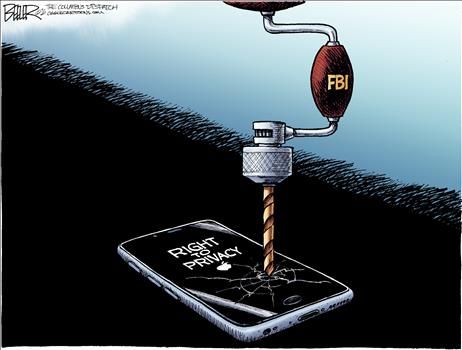
After the recent shooting at a health center in San Bernardino, California, there has been much speculation about who the shooters were, what their intentions were, and how they were able to carry out the kind of attack they did. While the FBI does possess one of the shooter's phones, they cannot unlock it due to a password, as well as the privacy rights guaranteed by Apple, the maker of the phone. The US government is now asking Apple to create and install a software that would allow the phone to be unlocked, in order for more information to be discovered about the shooting, and the shooters themselves. While privacy is certainly a right that should be guaranteed to all citizens, when national security is at stake, companies should have an obligation to work with the government.
The political cartoon depicts the FBI putting a screw into an iPhone which reads, "Right to Privacy". The cartoon is arguing that the FBI is hurting the policies that Apple holds to be true with their intent on discovering what secrets the phone holds. Due to incidents in the past with national security, such as those brought up by Edward Snowden, Apple is standing firm on their policies. Their main concern is that with the development of a software that can unlock the phone, this software could be stolen in the future and used to unlock any iPhone that exists. While this is certainly a legitimate concern, it would seem that Apple technicians are specialized so completely and dominantly for their market, that they should be able to work around this issue when it comes to such a big problem as national security.
The incident in San Bernardino and the events that have followed it have upset many people on both sides of the issue. The entire country felt the effects of the shooting and the mourning that followed. Those that are worried about their privacy have valid concerns, however, sometimes the safety and well-being of the country must come before the individual. We must put our trust in Apple and believe that they will be able to work through this problem without risking our national security.
Subscribe to:
Posts (Atom)